Don’t hit it in the water!

How big of a tip would your caddie get if his last words to you before you teed off were – “Don’t hit it in the water”?  Most of you would be shocked if your caddie ever said that to you, but how many times have you said something like that to yourself?  When we are faced with a difficult challenge like hitting the ball over the water, we sometimes get too focused on the consequences and not the process of executing.  IMPORTANT information ahead – Your brain is going to remember the last thing that you say before you hit the ball.  If that last thing is “water”, your brain will remember that and forget about the “don’t hit it in the” part.

The simplest way to avoid this negative thinking is to focus more on the target and not the trouble surrounding it. The trouble helps to define what your target is.  If there is out-of-bounds close to the right side of the fairway, perhaps your target should be the left center of the fairway.  Pick  your target and focus on it during your pre-shot routine and when you are executing the shot.

Here is a simple plan to follow the next time you are facing a challenging shot:
Step 1.  Define your target
Step 2.  Visualize a successful shot
Step 3.  Take a practice swing and again visualize success
Step 4.  Take a deep, relaxing breath
Step 5.  Hit the ball at your target with confidence

You have a choice over every shot to be positive or negative.  Choose the positive path and focus more on your target and not the trouble surrounding it.

Trackman Users Conference

2 weeks ago I was in Orlando for the Trackman Users Conference.  There were about 100 Trackman users and guests in attendance and it was a GREAT learning experience.  The highlight for me was watching PGA Tour player Kevin Streelman hit balls with his coach Darren May.

They explained how they use Trackman to help Kevin with his game.  Using parameters they have measured when Kevin is playing well, it is easy for them to figure out what they need to work on.  Kevin hit a few balls and worked his way up to the driver.

Kevin’s main issue is that he tends to fire his right hip out towards the ball causing him to lose his spine angle at impact.  This move causes his hands and the shaft to raise up as he comes through the ball.  This leads to a flippy release at the bottom and shots that can go both left AND right.  They don’t use video to look at this, they rely on the numbers that they get from Trackman.

The number they were looking at was the Swing Plane number.  This is basically the angle of the shaft in relation to the ground as the club contacts the ball.  A higher number would be a more vertical shaft position (90 degrees would be straight up or perpendicular to the ground) a lower number would be a flatter angle (0 degrees would be parallel to the ground).  About 45 degrees would be good for a driver.  When Kevin is playing well, his Swing Plane with the driver is 44 to 46 degrees.  When he starts to lose his spine angle, his Swing Plane number gets up to 49 or 50 degrees.  I have a swing of Kevin’s on Trackman and his Swing Plane is 46.1


The day we were at the conference, Kevin’s Swing Plane was in the 48 – 50 range.  He had not worked with his coach in about 3 or 4 weeks, and he got away from what he was working on.  Knowing what his numbers are gives him a clear picture of what he needs to work on.  They were heading to the range later in the day for a 4 hour practice session.

What a great and simple way to stay on track with your game.  Most people take lessons when they are playing poorly.  How helpful would it be to take a lesson when you are playing your best and document your numbers.  You can see what your parameters are when you are swinging well and then if you get away from that you will clearly see what you need to fix.

Mark Anderson joins MyPhillyGolf.com as Teaching Professional

I am very excited to join the team at MyPhillyGolf.com as the Teaching Professional.  I am looking forward to contributing golf tips, videos and my thoughts on golf instruction, professional golf and golf in Philadelphia.  It is an exciting time for golf in the Philadelphia area and no one covers it better than MyPhillyGolf.com.

Tee Height

How high should you tee your ball?  High enough! How is that for an answer?  All kidding aside, it will vary for different players, but generally speaking, you should tee your ball high enough so that when you hit the ball you are contacting the ball slightly above the sweet spot of the club.  This will cause the ball to launch higher and will reduce some of the spin on the ball.  This type of shot – High launch, low spin is the magic formula for longer tee shots.

A good guideline for tee height is to tee the ball high enough so the middle of the ball is at the top of the driver.


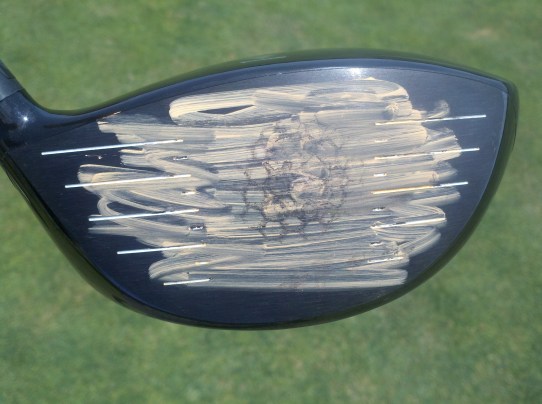
This is a good starting point for most players, but you need to take it a step further.  You need to find out where you are hitting the ball on the face to find the optimum tee height for your swing.  The best way to do this is to use a dry erase marker and cover the face of your driver.  After you hit a few shots, you will notice where you are hitting the ball on the face.  Ideally, you would want to hit the ball slightly above the center of the face to get the high launch – low spin shot.

If you have a driver with a black face, I have found that a neon colored dry erase marker shows up really well.  If you have a grey or silver colored face a black dry erase marker will work great.

Check your tee height and where you are contacting the ball on the face and you could make a simple adjustment that could add some serious distance to your tee shots.

Watch the video below to see what a difference the proper tee height can make.

Impact Drill

Impact is the moment of truth in the golf swing.  Most amateurs struggle with their ball striking because they don’t have a solid impact position.  Good ball strikers may have different set ups, grips, positions at the top of the swing and finish positions, but they are all solid at impact.  What makes a good impact position?  When striking an iron, the hands should be in front of the ball, the weight is shifting to the front foot (about 70%) and the hips are slightly open to the target (about 30 degrees).  If you can improve your impact position, you will improve your ball striking.

Here is a video tip to help you with your impact position.

Trackman success stories

I have had an incredible month since my Trackman unit arrived at the beginning of May and I wanted to share a few success stories.  I knew Trackman was incredible technology, and after using it for the past month I will admit that it is way better than I thought.  To be able to accurately show students what they are doing at the moment of impact is unbelievably helpful.  My thoughts on using Trackman are simple:  I am going to make changes that are going to directly improve your contact and your ball flight.  I have had more than a few cases where the student makes the change and improves in the very next swing.  There are times when more than a few adjustments are necessary to improve ball flight but here are a few that have been quick and dramatic.

Story #1  Watch your tee height

A few weeks ago I worked with Justin Smith, a good collegiate player that was struggling a little bit with his swing.  We worked on his irons for a little while and improved his contact and ball flight.  We then looked at the driver and I put some dry erase marker on his driver face to see where he was contacting the ball.  After 3 shots we looked at the numbers and 2 things were very clear:  On average, he was launching the ball low and spinning it too much.  We looked at the face and he was striking the ball below the center of the clubface.  This will cause the ball to launch lower due to the curve of the driver face from top to bottom (also known as roll), and spin more due the vertical gear effect of a strike below the center of the face.  We made a simple change of teeing the ball up about 1 inch and with the next 6 swings he gained almost 20 yards of carry distance and 17 yards of overall distance on average.

Story #2  Start slow to get the motion and then speed up

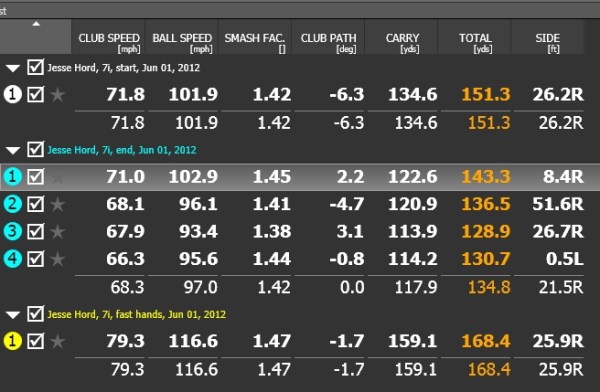
I have been working with Jesse Hord from the Cricket Club for a couple of months and we are working on getting rid of his over the top swing and outside – in swing path.   We worked on starting slow to get the proper motion.  Near the end of the lesson I put a few swings on Trackman and saw that his path was much better.  In some cases his path was moving out to the right, which is a huge improvement considering how far left his path was when he started.  After reviewing the shots, I noticed that the swing speed was still a little bit slow and gave Jesse a quick tip to speed his hands up through impact.  I put the next swing on Trackman to see what the difference was and it was amazing.   His clubhead speed went up 11 miles per hour and he carried it 40 yards longer than the average of his 4 previous shots and 25 yards longer than when he started the lesson.
Story #3  Why is the ball curving?

Kyle (who works at the Cricket Club) came up to the range to try out his new Titleist AP2 irons the other day – the same irons that I play.  I wanted to see how he was hitting them and noticed that he was over-drawing every shot and they were finishing way to the left of the target.  He noticed the Trackman and asked about it so I asked him to hit a few shots.  He hit 5 balls and we looked at the numbers.  He is a hockey player and generates a lot of clubhead speed, but his path is going too far out to the right.  I showed him the numbers and explained that if he swings a little bit more to the left that his ball would curve less.  It is tough for some people who hit the ball to the left to understand that they need to swing to the left.  If you have Kyle’s shot pattern, you need to do just that to get the ball to curve less and finish closer to the target.  His next 5 shots were recorded on Trackman and he cut his dispersion by 50%.  His average shot was now 14.5 ft from the target compared to 31.3 ft.  Easy game when you know exactly why your ball is doing what it is doing and what you have to do to fix it.


I am looking forward to many more of these stories and sharing them with you.

Who should use Trackman?

This is a simple question with an easy answer.  Anyone that wants to improve their ball-striking could benefit from using Trackman.  Does it mean that I use it with every single lesson? No, but it certainly is helpful to increase the student’s understanding of what they need to do with their swing to improve their numbers and their ball flight.  I had a lesson with Nik the other day who is a total beginner.  He is athletic (surfer, snowboarder, x-games type), but totally new to golf.

I put him on Trackman and the biggest thing that we looked at was his clubface.  When he started the lesson he was hitting every shot to the right – in some cases over 100 ft. right of the target.  We made a small tweak to his grip and worked on the tension in his hands and arms.  He started the lesson with a face position that was 12-20 degrees open at impact.  We discussed the relationship of the face to the starting position of the ball and worked on squaring the face at impact.  By the end of the lesson his face position was only 2 to 4 degrees open and he hit a beautiful draw that we captured on Trackman that finished 4.5 ft right of the target.  Well done Nik!!!

Trackman has arrived!!!

I am very excited to announce that my Trackman unit arrived from Denmark on Friday, May 4th.  I will be testing everything today and will begin using TM with my lessons this week.  There are so many ways that Trackman can help you with your game.  Check out the Trackman section on my website for more information.  If you want to improve your ability to control the flight of your golf ball and to start playing the best golf of your life,  set up your Trackman lesson today!

Penn Women’s Golf – 2nd at Ivies

Congratulations to the Penn Women’s Golf team for their 2nd place finish at the Ivy League Championship over the weekend.  We had a crazy season but they all hung in there and stuck together.  I am so proud of all of you and your efforts.  Congrats to Isabel Han for her 2nd place finish and First Team All-Ivy honor.  Freshman Amanda Chin had a great 74 in the final round and finished in 6th place …- Second Team All-Ivy.  GREAT JOB!!!Unfortunately, the best team doesn’t always go home with the trophy.  You guys are the best.  Thanks for a great season!  #1proudcoach

Hats off to our Captain/Team Manager – Tiffany Cheung, for a great 4 years at Penn.  She was the glue that held the team together. Great to have “The Beast” back with us as well. Congrats to the Penn Men’s team for their exciting victory at Galloway.  Way to go guys – well done!!!